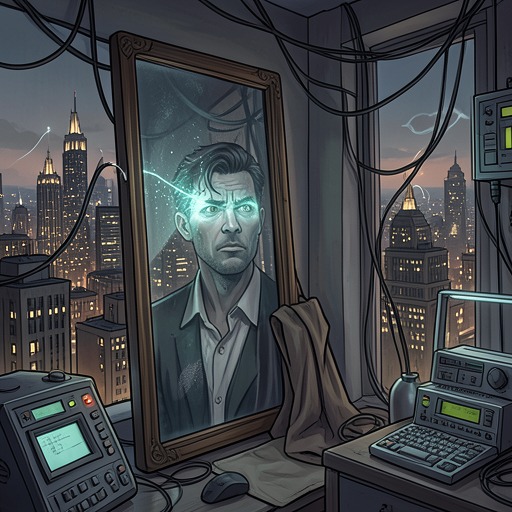
Stockholm’s electrical disturbance
Handling the UndeadStockholm’s electrical disturbance turns familiar electricity into an oppressive presence: appliances continue running, plugs crackle with sparks, and a force no one can see becomes physically painful. Its sudden disappearance offers relief but no explanation, making the event a brief, unresolved rupture in ordinary life.
Onset and Escalation
Earlier in the evening, the disturbance feels like an approaching thunderstorm. The comparison suggests pressure gathering in the air, but the expected signs of a storm never arrive: the sky is clear, there is no distant rumble, and no rain or thunder promises release. Instead, an invisible electrical field grows gradually more intense. Its presence is confirmed not by sight but by the people who feel it, until the tension becomes nearly unbearable.
The progression is both slow and difficult to mark. The field increases in strength almost imperceptibly, so that an atmosphere initially described through the familiar language of weather becomes something more alarming without a clear moment of transition. The disturbance supplies the pressure of a storm while withholding its visible form and natural conclusion. There is no cloud to watch, no bolt to follow, and no ordinary change in the sky that could make the threat legible.
The Reverse Blackout
The event’s most concrete effect is an inversion of a blackout. Since around nine o’clock, lamps cannot be switched off and electrical appliances cannot be powered down. Pulling a plug does not break the circuit: crackling sounds and sparks leap between the outlet and the plug, preventing disconnection. Electricity, ordinarily useful because it can be directed and stopped, instead insists on continuing.
That failure of control reaches beyond a single device. At a restaurant, kitchen fans that had been turned on to lessen the heat from cooking ranges that could not be switched off become another source of the same problem. The fans make conversation difficult, even as they provide some relief from the heat. The scene makes the anomaly practical and immediate: efforts to manage one consequence of the malfunction leave people coping with another. The electrical disturbance is not simply a strange spectacle; it rearranges ordinary activity around equipment that can no longer be reliably controlled.
Bodily Effects and Public Signs
The invisible field also registers through pain. Henning experiences it as an electric fence around his head, with shocks pulsing through him. The pressure becomes so severe that he expects his head to cave in and waits for an explosion. The description gives the unseen disturbance a bodily boundary: it cannot be touched, yet it seems to press against and torment the person inside it. Henning’s anticipation of a final bang makes the pain feel as though it is building toward a catastrophic release.
The effects are visible in public, even though the field itself is not. On Sveavagen, people look down at the ground, and some press their hands against their temples. An ambulance passes with its siren blaring; the account leaves open whether it is responding to an emergency or whether the siren, like the other electrical equipment, cannot be turned off. Parked cars idle in place. These details do not establish the cause of each incident, but they show how the disturbance makes routine urban machinery seem unreliable and makes private pain part of a shared scene.
The event is also reported as geographically bounded, at least according to the ten o’clock radio news: the electrical phenomenon appears confined to the Stockholm region. The current in some areas is compared with an incipient lightning strike. That report gives the crisis a regional scale without making its limits certain. The comparison remains a measure of intensity, not an explanation of what is happening.
Abrupt Cessation
For Henning, the pain reaches its height in a moment of expectation. The light from the windows seems stronger, and leaf shadows form a psychedelic pattern over his body as he turns his face toward the sky, opens his eyes, and waits for the anticipated explosion. Instead, a small ping is followed by the field’s disappearance. It is gone as suddenly as if a switch had been thrown; the headache vanishes, and the sensation of a swarm of bees stops at once.
The switch-like ending reverses the event’s central disturbance. During the crisis, devices cannot be switched off; at its conclusion, the field itself ceases without warning. The cessation brings immediate bodily relief, but the account supplies no cause for it and no sign that anyone has gained control over the phenomenon. Its ending therefore closes the episode’s physical pressure while leaving its meaning unresolved.
Narrative Significance
The disturbance makes the familiar strange by changing what ordinary electrical objects can do. A lamp remains lit, a fan continues to roar, a plug throws sparks, and a siren may not stop. These are not images of technology disappearing but of technology persisting beyond human command. The reverse blackout is unsettling precisely because the systems remain active while their simplest function, being switched off, fails.
The narration moves between that shared material disruption and the intensely personal experience of pain. The radio gives the phenomenon a name and a provisional regional range; Henning’s experience supplies no comparable distance from it. His waiting for an explosion stretches the moment before the expected release, only for the disturbance to end with a ping and an immediate silence of sensation. The contrast between anticipated catastrophe and abrupt cessation makes the event’s disappearance as uncanny as its arrival: the field becomes perceptible through its effects, then leaves no explanation behind.